Loading
Just a moment…
Loading
Just a moment…
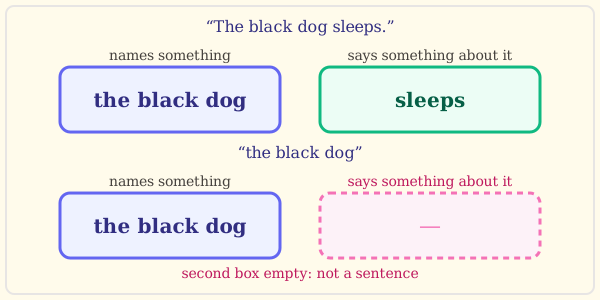
Read these two out loud:
One of them leaves you hanging. You want to ask: the black dog what? The other one is finished. Nobody would ask you “and then what?”
You already do this every time you talk. You have just never had to name it. This week you learn the name, and the two small marks that close a sentence.
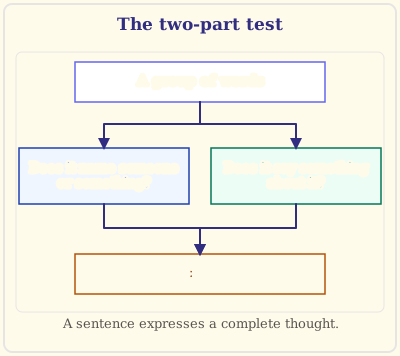
A sentence is a group of words that expresses a complete thought.
That test has two parts, and a real sentence needs both:
A group of words that fails the test is a fragment — a piece of a sentence, cut off too soon.
This rule has no exceptions: every sentence begins with a capital letter.
A capital letter is the big form of a letter — T, not t. The very first letter of the very first word is always the big one.
It does not matter which kind of sentence it turns out to be. Telling, asking, long, short — the first letter is a capital, every time. Not even the second sentence in a row gets to skip it.
A declarative sentence tells something. It states a fact, describes something, or gives you information — and it always ends with a period (.), the small dot that closes a sentence.
Each one tells you something and then stops. Nothing is being asked for.
Two words to keep straight: declarative is the kind of sentence; period is the mark it ends with.
An interrogative sentence asks something. It wants information back — and it always ends with a question mark (?), the curled mark that closes a question.
There is an ear trick, but it only works on some questions. On one you could answer yes or no, like “Is the soup hot?”, your voice lifts at the end. On one that starts with who, what, where, when, why or how, your voice usually does not lift, so the trick fails.
The test that never fails is the wording: is this sentence asking me something, or telling me something?
Here is the slip that catches almost everyone in week one.
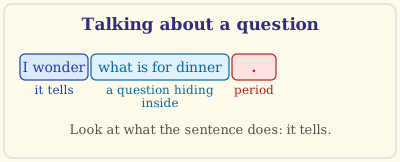
A sentence can talk about a question without asking one.
“I wonder what is for dinner.”
There is a question hiding inside it — what is for dinner? — but the sentence itself is not asking you anything. It only tells you that someone is wondering. So it is declarative, and it takes a period.
Only a sentence that does the asking itself is interrogative. Look at what the sentence does, not at which words are hiding inside it.
Try the whole routine on two fresh groups of words.
“the old wooden fence behind the barn” — Test 1: does it name something and say something about it? It names the fence, but nothing is said about the fence. It is only a long label, so it fails the test. It is a fragment, no matter how many words it has.
“Have you fed the goldfish yet?” — Test 1: it names you and says something about you — asks whether you have fed the goldfish. It passes, so it is a sentence. Test 2: is it telling or asking? It wants information back, so it is interrogative, and it needs a capital letter at the start and a question mark at the end.
The naming-plus-saying test works because a reader's mind needs both pieces before it can picture anything. Give a reader only a name — “the old wooden fence” — and their mind is left waiting, the way your ear waits after the black dog. Give them a name and something said about it, and the picture completes itself.
That is also why the end mark matters so much. A period tells the reader the thought is finished and information is being handed to them. A question mark tells the reader the thought is finished and information is being asked of them. Leaving off the right mark, or using the wrong one, makes a reader guess which job the sentence is doing.
You might be tempted to think a long, detailed group of words must be a sentence. Don't — length has nothing to do with it. Only the two-part test decides.
The enormous, sleepy, gray elephant by the watering hole. — many words, but it only names the elephant. Nothing is said about him. Still a fragment.
The elephant drinks. — only three words, but it names the elephant and says what he does. A complete sentence.
Always run the two-part test, even on a group of words that looks impressively long.
Four lines. Say them out loud to yourself until you can do all four without looking.
The exact words matter. “Complete thought” does not become “whole idea,” and “period” does not become “dot.” Getting the words exact now is what makes the rule automatic later, when you are writing and not thinking about it.