Loading
Just a moment…
Loading
Just a moment…
This week you meet your first Latin verb: amō, amāre — "to love." By the end of this lesson you will be able to build any regular verb like it through all six persons, with the macrons in the right place.
You already know one fact you need: a macron, the line over a vowel like ā, marks a long vowel. Keep that fact close — it is about to matter every day.
A conjugation is a family of verbs that add their endings the same way. Almost every Latin verb belongs to one (a few irregular verbs, like sum, do not), and once you learn the pattern for a single verb you can do every verb in that family. Latin has four conjugations. This lesson teaches the first conjugation — the largest and friendliest family, easy to spot because its verbs are built on the vowel a.
Three small English grammar words, defined once so you can use them freely:
The infinitive is the naming form of a verb, matching English “to ___”. In Latin it is the second principal part, and for this conjugation it ends in -re.
Principal parts are the four dictionary forms that let you build every other form of a Latin verb — a Latin verb is listed with up to four of them. For our model verb they are:
amō, amāre, amāvī, amātum — to love
You will learn what the third and fourth parts are for later in the year. For now, you use the first two:
The present stem is the part of the verb you add endings to. To conjugate in the present tense, take the infinitive amāre and drop the -re:
amāre → drop -re → amā- (the present stem)
The stem amā- carries the meaning love. Everything else you do is attach an ending that tells you who is doing the loving.
A Latin verb ending does the work that English does with separate pronoun words (I, you, he, we, they). One ending answers two questions at once:
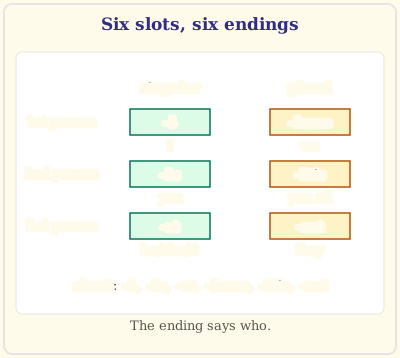
Three persons times two numbers gives you six slots, and each slot has its own ending:
| Singular | Plural | |
|---|---|---|
| 1st person | -ō (I) | -āmus (we) |
| 2nd person | -ās (you) | -ātis (you all) |
| 3rd person | -at (he/she/it) | -ant (they) |
Recitation order — memorize this exact sequence, like the alphabet: -ō, -ās, -at, -āmus, -ātis, -ant.
(The ā in -ās, -āmus, -ātis is the stem's own vowel; what you add to the stem is -ō, -s, -t, -mus, -tis, -nt.)
Every form in this lesson is present tense — happening now — and active voice — the subject is doing the action, not receiving it. So whenever you parse a form in this lesson, its tense is present and its voice is active, every time.
Attach each ending to the stem amā- and you get the full present active of amō:
| Person / Number | Latin | Pronunciation (ecclesiastical) | English |
|---|---|---|---|
| 1st singular | amō | AH-moh | I love / I am loving |
| 2nd singular | amās | AH-mahs | you love |
| 3rd singular | amat | AH-maht | he loves / she loves / it loves |
| 1st plural | amāmus | ah-MAH-moos | we love |
| 2nd plural | amātis | ah-MAH-tees | you (all) love |
| 3rd plural | amant | AH-mahnt | they love |
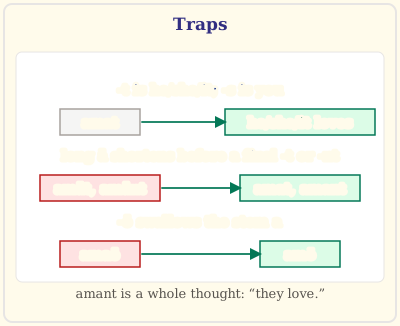
One form, one whole thought. Because the ending already tells you who, Latin usually needs no separate pronoun word. amat by itself means he loves (or she loves, or it loves — context decides). Likewise amō = I love; you do not add a word for "I." This is the heart of this lesson: a single Latin verb is already a complete sentence.
Each present-tense form can be turned into English three ways, all correct: amō = I love, I am loving, or I do love. Learn the plain form (I love) first and simply recognize the other two.
Read-aloud notes (ecclesiastical pronunciation):
Look carefully at the stem vowel ā across the paradigm. It stays long in most forms — but in a few places it changes, and you need to know why, so you never guess a macron:
Hold these two facts together and the whole paradigm is predictable: long ā everywhere except the contracted -ō form and the shortened -at / -ant forms.
A note on longer stems. In a verb like labōrō (to work), only the final stem vowel — the ā — obeys these rules. The earlier long ō in labōr- is part of the word's root and never changes: labōrō, labōrās, labōrat, labōrāmus, labōrātis, labōrant. The same is true of ōrō (to pray): the opening ō stays, and only the final ā shortens before -t/-nt (ōrat, ōrant).
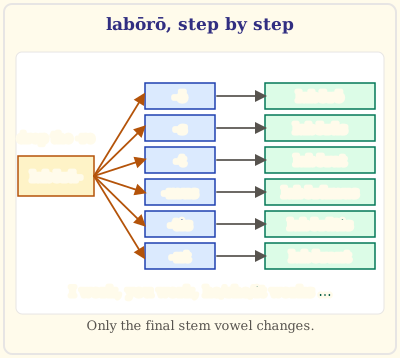
Step 1 — Find the stem. labōrāre → drop -re → stem labōrā-. Step 2 — Add each ending in order, applying the two rules as you go. (The leading ō of labōr- never changes; watch only the final ā.)
| Slot | Build | Result | Why |
|---|---|---|---|
| 1 sg | labōrā- + -ō | labōrō | -ō contracts away the final stem a |
| 2 sg | labōrā- + -s | labōrās | long ā kept |
| 3 sg | labōrā- + -t | labōrat | final ā → a before -t |
| 1 pl | labōrā- + -mus | labōrāmus | long ā kept |
| 2 pl | labōrā- + -tis | labōrātis | long ā kept |
| 3 pl | labōrā- + -nt | labōrant | final ā → a before -nt |
Read it aloud: lah-BOH-roh, lah-BOH-rahs, lah-BOH-raht, lah-boh-RAH-moos, lah-boh-RAH-tees, lah-BOH-rahnt. Meaning: I work, you work, he/she/it works, we work, you (all) work, they work.
Step 1 — Stem. ōrāre → ōrā-. Step 2 — Conjugate. Same pattern, same two rules. The opening ō stays long throughout.
| Slot | Result | English |
|---|---|---|
| 1 sg | ōrō | I pray |
| 2 sg | ōrās | you pray |
| 3 sg | ōrat | he/she/it prays |
| 1 pl | ōrāmus | we pray |
| 2 pl | ōrātis | you (all) pray |
| 3 pl | ōrant | they pray |
Notice you did not have to learn a new pattern — you reused amō's six endings exactly. That is the whole payoff of the conjugation family: learn one verb, do them all.
Try each of these on your own, out loud, then check your answer.
| Prompt | Think it through | Answer |
|---|---|---|
| Give the present stem of vocō, vocāre (to call). | Drop -re from vocāre. | vocā- |
| Conjugate vocō in the 2nd singular ("you call"). | stem vocā- + -s. | vocās |
| Conjugate laudō, laudāre (to praise) in the 3rd singular. | stem laudā- + -t; ā shortens before final -t. | laudat |
| Conjugate portō, portāre (to carry) in the 1st plural. | stem portā- + -mus; long ā kept. | portāmus |
| What is wrong with writing amānt for "they love"? | ā must shorten before final -nt. | The correct form is amant (short a). |
| Translate ōrant. | 3rd plural of pray. | they pray |
Read these five one-word Latin sentences aloud, then say the English translation to yourself. You will be asked about them below.
Because the ending already names the subject, each one is a complete sentence by itself. There is no separate Latin word for I, you, he, we, or they here — the ending supplies it.
Each verb is given by its four principal parts. This week you use only the first two — the "I" form and the infinitive — to conjugate the present tense; the third and fourth parts are introduced now only so the full dictionary listing is familiar.
| Latin (principal parts) | Meaning | English derivative to remember |
|---|---|---|
| amō, amāre, amāvī, amātum | to love, to like | amorous, amiable, amateur |
| laudō, laudāre, laudāvī, laudātum | to praise | laud, laudable, laudatory |
| portō, portāre, portāvī, portātum | to carry | transport, portable, porter |
| vocō, vocāre, vocāvī, vocātum | to call | vocation, invoke, revoke |
| ōrō, ōrāre, ōrāvī, ōrātum | to speak, to pray | oration, oratory, orator |
| labōrō, labōrāre, labōrāvī, labōrātum | to work | labor, laboratory, elaborate |
Say the six endings once more before you move on: -ō, -ās, -at, -āmus, -ātis, -ant.