Loading
Just a moment…
Loading
Just a moment…
By the end of this lesson you will be able to pull an argument apart into its conclusion and its premises, list the terms a statement is built from, run four questions on any argument you meet, and give a verdict on the argument itself rather than on whether you like its conclusion.
One word before you start, because the warm-up below uses it. A statement is a sentence that can be true or false. “The gate is open” is a statement; a question or an order is not, because neither can be true or false.
Learn these two sentences. You will use sentence 2, the one about terms, every week this year.
1. An argument is a conclusion together with the statements offered to support it.
2. Statements are made of terms, and a term is the class a word or phrase picks out — the thing or group being talked about, such as dogs or wet things; the same word can carry two different terms.
Coming up later in this lesson: a third thing to learn by heart, the four questions you will use on every argument from here on. They ask what is claimed, what supports it, what the terms are, and whether all the support could be true with the claim still false.
Here is an argument someone might say on an ordinary afternoon, and nobody objects.
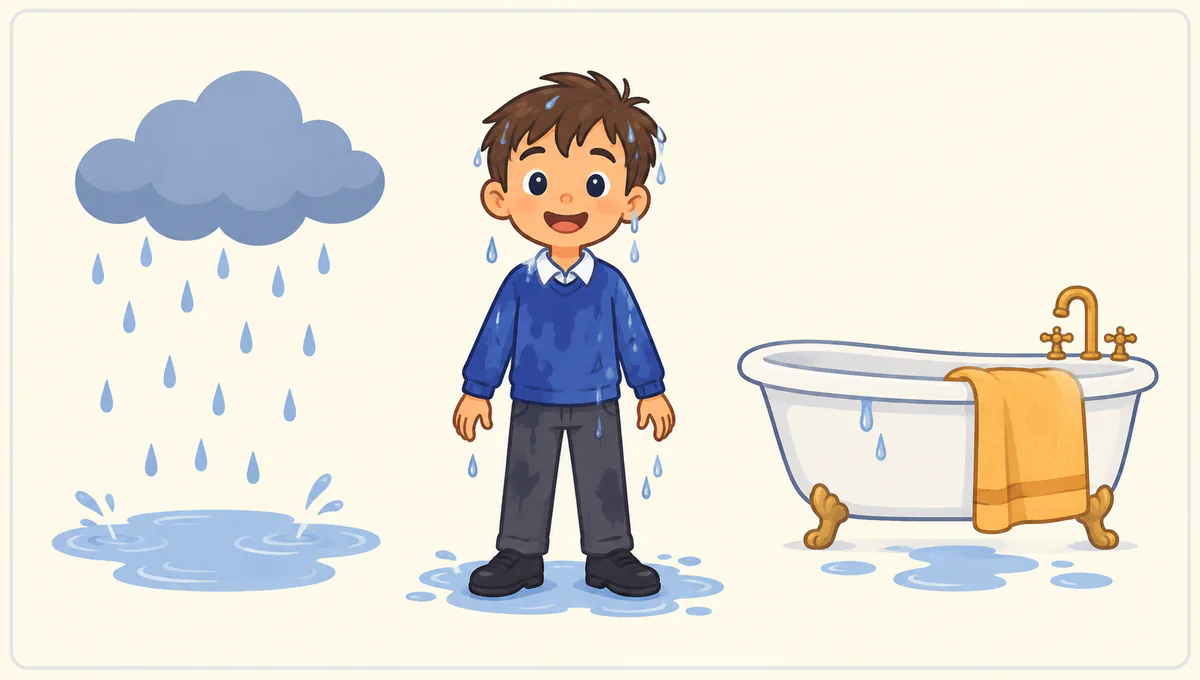
Everyone who has been out in the rain is wet. Thomas is wet. So Thomas has been out in the rain.
Read it again. It sounds like adding up, and it settles nothing. Thomas may indeed have been in the rain, but that is not the point. Suppose instead he has just come out of the bath. Both statements you were given are still true, and the thing you were told to believe is false.
The two statements do not join. The first reaches every person who has been in the rain and calls them wet. It says nothing about how the wet people got wet. The second puts Thomas among the wet people. There the trail stops.
Here is the same build, plainer:
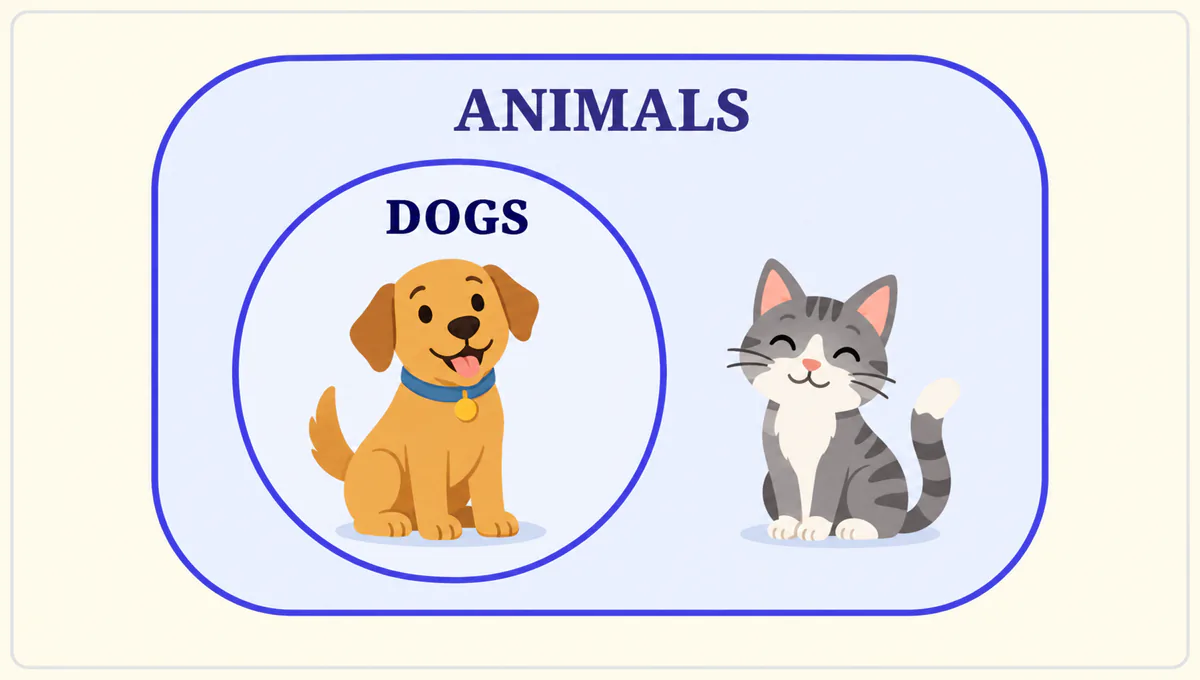
Every dog is an animal. My cat is an animal. So my cat is a dog.
Nobody is fooled by that one. Both its statements are true, its last statement is false, and it is built exactly like the argument about Thomas. That settles it: the build itself is no good. An argument whose build guarantees the conclusion whenever the premises are true is called valid; one whose premises could all be true while the conclusion is false, like this one, is invalid. Notice that both arguments here are invalid even though every premise in them is true — validity is a verdict on the build, not on the facts.
Notice what you could not have said without pulling the argument apart. You could not simply say Thomas was in the bath and call it settled — you would be arguing about Thomas when you should be arguing about the argument. The two verdicts, whether it follows and whether it happens to be true, are different jobs, and this whole year rests on keeping them apart.
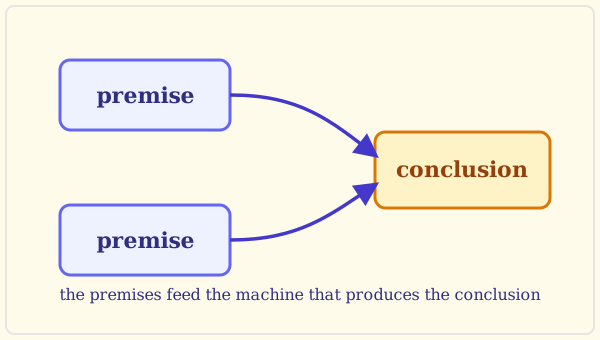
An argument is not a quarrel, nor one thing said loudly. It is a small machine with named parts. The part you are asked to believe is the conclusion. The parts offered to make you believe it are the premises. Take away either and there is no argument: premises with nothing to support are only remarks, and a conclusion with nothing behind it is only an assertion.
Each of those parts is a statement, something that can be true or false. Each statement is built out of terms. A word or phrase picks out a class, and that class is the term. A name like Thomas picks out a term with one member.
| Size | In the failing argument |
|---|---|
| The argument | All three statements together |
| One statement | Thomas is wet |
| Its terms | Thomas; wet things |
Here are the four questions. The same four every time, and by the end of the year you will run them without noticing.
Question four does the real work, and it is worth saying what it does not ask. Not whether the conclusion is true. Not whether you like it. Not whether the speaker is usually right. It asks one thing: does the conclusion have to follow?
That is why the argument about Thomas fails even though Thomas may well have been in the rain. Keep two verdicts apart all year: whether the conclusion follows from the premises is about the argument; whether the premises are true is about the world. You will meet arguments that pass the first and fail the second, and arguments that fail the first while the conclusion happens to be true. Keeping them apart is most of the skill.
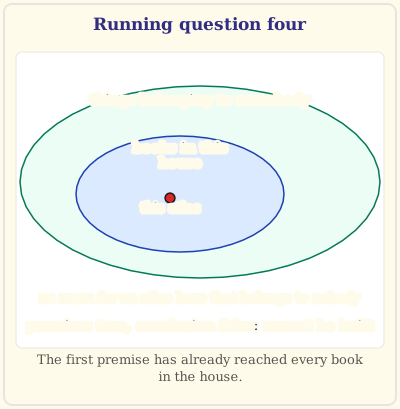
The argument: Every book in this house belongs to somebody. This atlas is a book in this house. So this atlas belongs to somebody.
Predict the verdict before you touch the questions. Question one: what am I asked to believe? That the atlas belongs to somebody — the conclusion. Question two: what is offered? Two premises: every book in the house belongs to somebody, and the atlas is one of those books. Question three: the terms are books in this house, things belonging to somebody, and this atlas, and each appears twice meaning the same both times.
Question four: could the premises be true and the conclusion false? Try to build it. You would need an atlas that is a book in this house and yet belongs to nobody — but the first premise has already reached every book in the house, so there is no gap. Verdict: the argument holds. Notice what was never settled: whether the atlas really is in this house. That is a fact about the world, and question four never touched it.
Here are four short arguments. We will call them cards 1 to 4, and the next pages refer back to them by number. For each card, predict where its conclusion sits before you decide.
A conclusion is found by the job it does, not by where it sits. Words like so and therefore often point at it, but on one of these cards nothing points at it at all.
Cards 1 and 4 put the conclusion last, signalled by so. Card 2 states its conclusion first ("Carmen is at home") with no signal word at all. Card 3 buries its conclusion in the middle ("this pair was left by the door").
Cards 3 and 4 do not hold up, even though they feel natural. Card 3 (the boots) has the same shape as this made-up comparison: Every oak is a tree. This pine is a tree. So this pine is an oak. True premises, false conclusion, same build.
Card 4 (the snow and the school) fails because its first statement says snow is enough to shut the school, not that it is the only thing that would, so the school could be shut for another reason with no snow at all. The same build fails in this made-up comparison, which is about animals rather than school: If it is a dog, it is an animal. This creature is not a dog. So this creature is not an animal — but the creature could be a cat.
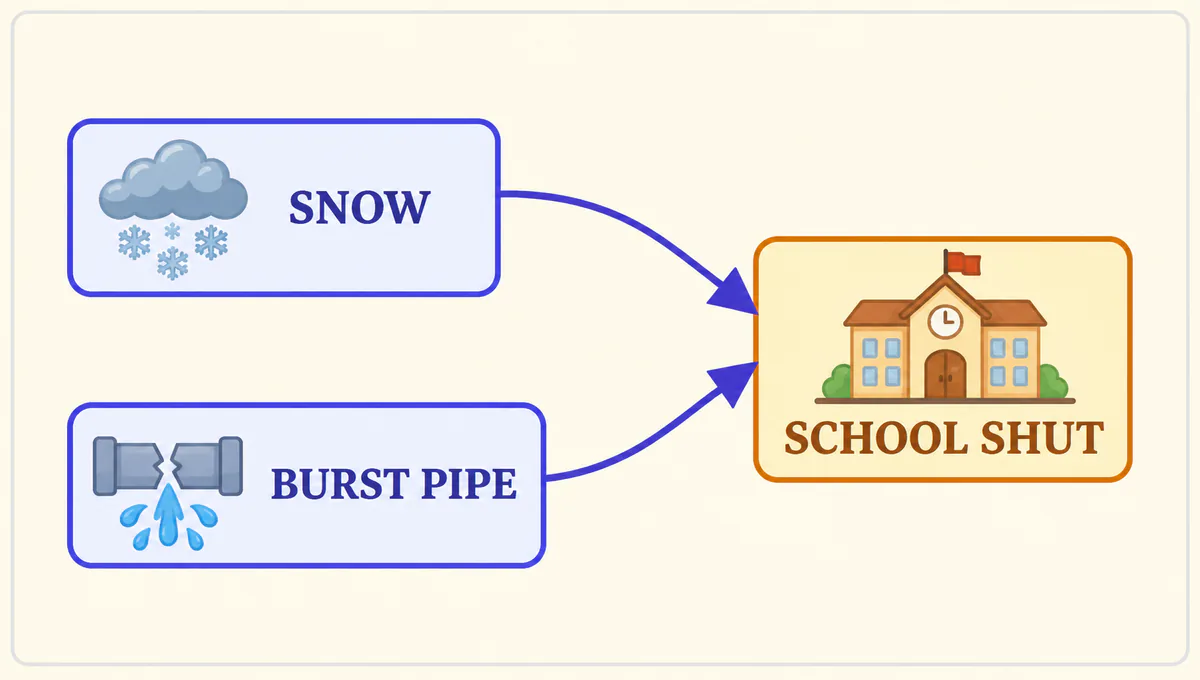
You might be tempted to think an argument is fine just because its conclusion turns out to be true. Don't — the argument about Thomas fails even though Thomas may really have been in the rain. Judge the build, not the conclusion.
You might be tempted to think the conclusion is always the last statement. Don't — card 2 states its conclusion first, with no signal word marking it at all. Find it by asking which statement the others are there to support.
You might be tempted to think a premise is simply anything the speaker believes. Don't — a premise is named by the job it does in one particular argument. The same sentence can be a premise in one argument and a conclusion in another.
| Word | Meaning |
|---|---|
| argument | a conclusion together with the statements offered to support it |
| conclusion | the statement an argument is trying to get you to accept |
| premise | a statement offered in support of a conclusion |
| term | the class a word or phrase picks out; the same word can carry two terms |
| valid | said of an argument whose conclusion has to follow from its premises |
You have mastered this lesson once you can separate conclusion from premises in a new argument, list its terms, and give your verdict on the argument itself.