Loading
Just a moment…
Loading
Just a moment…
Every whole number you will ever write uses only ten symbols: 0, 1, 2, 3, 4, 5, 6, 7, 8, 9. Each symbol is called a digit. The same digit means something different depending on where it sits — a 4 in one spot can be worth 4; the same 4 somewhere else can be worth 400,000. By the end of this lesson you will name any digit's place and find its exact value.
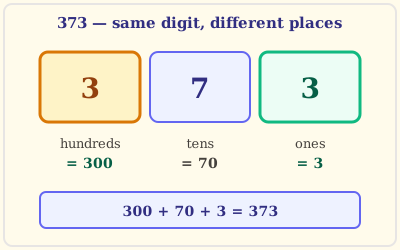
A digit is a single symbol from 0 through 9. It is not the whole number — 274 is a number, but 2, 7, and 4 are each a digit inside it. A number can use the same digit more than once, as in 373, where the 3 appears twice. Those two 3's are worth completely different amounts, because they sit in different places.
Say these three lines until you know them by heart:
"A digit is a single symbol from 0 through 9."
"A digit's place is its address: ones, tens, hundreds, thousands, counting from the right."
"A digit's value is the digit times its place."
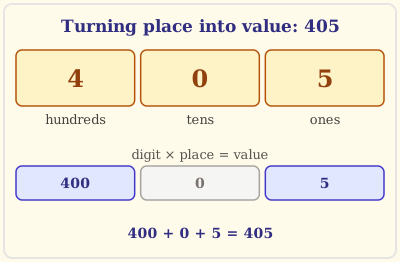
Every spot in a number has a name, called its place. Starting from the right: ones, tens, hundreds, thousands, ten-thousands, hundred-thousands. In 405, the 4 sits in the hundreds place, the 0 sits in the tens place, and the 5 sits in the ones place. Place works like a street address — it tells you exactly which digit you mean.
A digit's value is what it is actually worth in the number. To find it, multiply the digit by its place's worth: ones is worth 1, tens is worth 10, hundreds is worth 100, and so on. In 405, the 4 is in the hundreds place, so its value is 4 × 100 = 400. The 5 is in the ones place, so its value is 5 × 1 = 5. Adding every digit's value rebuilds the whole number: 400 + 0 + 5 = 405.
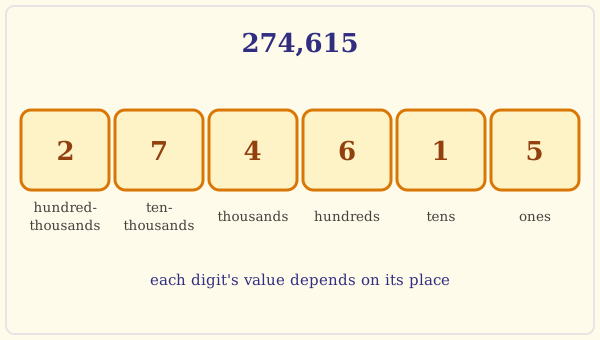
Find the value of the 7 in 274,615. Step 1: Locate the 7 — it is the second digit from the left. Step 2: Name its place by counting from the right: ones, tens, hundreds, thousands, ten-thousands, hundred-thousands. The 7 lands in the ten-thousands place. Step 3: Multiply: 7 × 10,000 = 70,000. The value of the 7 is 70,000 — not 7,000, which would be its value one place closer to the ones.
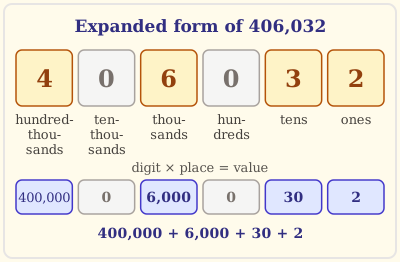
Expanded form writes a number as the sum of every digit's value. Find the expanded form of 406,032. Step 1: Name each place: 4 hundred-thousands, 0 ten-thousands, 6 thousands, 0 hundreds, 3 tens, 2 ones. Step 2: Multiply each digit by its place: 400,000; 0; 6,000; 0; 30; 2. Step 3: Add only the values that are not zero: 400,000 + 6,000 + 30 + 2. A zero digit holds its place but contributes nothing to the sum, so it drops out of expanded form.
Sometimes you are given the place and must find the digit. In 583,241, which digit sits in the hundreds place? Step 1: Count places from the right: 1 is ones, 4 is tens, 2 is hundreds, 3 is thousands, 8 is ten-thousands, 5 is hundred-thousands. Step 2: The hundreds place holds the digit 2. Counting from the right, not the left, is the safe habit — counting from the left would land on the wrong digit.

Walk the value example a second time. Find the value of the 7 in 274,615. Count places from the right: 5 ones, 1 ten, 6 hundreds, 4 thousands, 7 ten-thousands, 2 hundred-thousands. The 7 sits in the ten-thousands place. Multiply: 7 × 10,000 = 70,000. That is the same 70,000 the first value example already named. Reporting 7,000 names the thousands place, one place closer to the ones. Reporting 700,000 names the hundred-thousands place, where the 2 sits. Reporting 7 names the digit, not its value. None of those check.
A digit's value is the digit times its place. Count from the right. If a rewrite gives 7,000, it landed one place too close to the ones. The 7 is worth 70,000.
Expanded form of 406,032 writes each digit's value, then keeps only the values that are not zero: 400,000 + 6,000 + 30 + 2. That is the same 400,000 + 6,000 + 30 + 2 the first expanded-form example already named. Writing 40,000 + 6,000 + 300 + 2 moves the 4 into ten-thousands and the 3 into hundreds. Writing 400,000 + 60,000 + 32 treats the 0 ten-thousands as a 6 and glues 30 and 2 together. Writing 400,000 + 600 + 30 + 2 puts the 6 in hundreds. A zero digit holds its place but adds nothing to the sum, so it drops out of expanded form.
Name each place from the right, multiply, then skip zeros. If a rewrite gives 40,000, it shifted the 4 one place. The 4 is worth 400,000.
In 583,241, which digit sits in the hundreds place? Count from the right: 1 is ones, 4 is tens, 2 is hundreds. The hundreds digit is 2. That is the same 2 the first place-finding example already named. Counting from the left would start at 5, then 8, then 3, and land on 3 — the thousands digit, not the hundreds. Naming 8 names the ten-thousands place. Naming 4 names the tens place. None of those are hundreds.
Place names start at the ones, on the right. If a rewrite gives 3, it counted from the left. If a rewrite gives 8, it landed on ten-thousands. Count ones, tens, hundreds from the right.
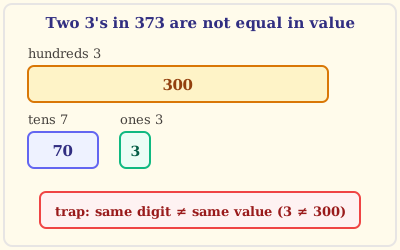
In 373 the digit 3 appears twice. Count from the right: the last 3 is ones, so its value is 3 × 1 = 3. The first 3 is hundreds, so its value is 3 × 100 = 300. Those two 3's are not worth the same amount. That is the same different-place rule the first digit example already named. Claiming they are worth the same because they look alike ignores place. Claiming there is no way to tell skips the place names. Adding 3 + 3 writes 6, which is not either value. The middle 7 sits in tens and is worth 70. Check: 300 + 70 + 3 = 373.
A digit's value depends on place, not on which symbol it is. If a rewrite says the two 3's match in value, it ignored the addresses. Count from the right, then multiply.
You might be tempted to think a repeated digit is always worth the same amount. Don't — value depends on place, not on which digit it is. You might be tempted to count places from the left. Don't — always count from the right, since place names start counting at the ones place. You might be tempted to leave a zero digit's place out of the number entirely. Don't — a zero contributes 0 to the sum, but the digits around it still keep their true places because of it.
Digit: a single symbol from 0 through 9. Place: the named spot a digit sits in, such as ones, tens, or hundreds. Value: what a digit is actually worth — its digit times its place. Expanded form: a number written as the sum of every digit's value, skipping any digit worth zero.