Loading
Just a moment…
Loading
Just a moment…
Every scientist starts the same way: by paying close attention to the world and reporting it honestly. This lesson teaches you to do three things well. You will learn to report an observation exactly as you gathered it, to mark an inference as your own guess about what it might mean, and to shape a testable question that evidence can actually answer. These three moves are the single most useful habit you will build all year.
Recite these three lines until you can say them from memory:
The word may in the second line is doing heavy work. A strong inference fits the evidence, but it stays an interpretation until more evidence supports it. You earn the right to drop the word may slowly, by gathering more evidence — never by simply sounding confident.
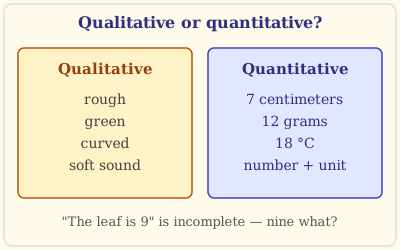
An observation can be qualitative — rough, green, curved, giving off a soft sound — or quantitative — 7 centimeters long, 12 grams, 18 degrees Celsius. A quantitative observation always carries two things together: a number and a unit. A number with no unit ("the leaf is 9") is incomplete, because nine what? Nine centimeters and nine millimeters describe very different leaves.
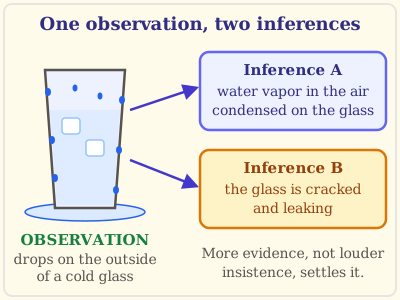
Seeing drops of water on the outside of a cold glass is an observation. Saying that water vapor in the air cooled and condensed on the cold surface is an inference — a good one, but still an interpretation. Saying instead that the glass must be cracked and leaking is a different inference from the very same observation. Two honest people can look at one puddle under a glass and reason toward two explanations; more evidence, not louder insistence, is what settles which one fits.
Careful scientific writing signals the difference on purpose. It uses phrases such as I observed… for evidence and This may mean… for interpretation. It does not disguise a guess as a fact by writing it in a confident voice. A useful test for any sentence is to ask: could a second person, standing beside me, have gathered exactly this with their own senses or a tool? If yes, it belongs with the observations. If it requires you to explain, predict, or supply a history, it is an inference, and you should label it as one so a reader is never misled.
Not every question belongs in a science notebook. A scientific question has to be narrow enough to investigate and must point at something you can observe or measure. Which color is the most beautiful? asks for a preference, and no amount of measuring will settle a preference. Does the color of paper change how quickly it warms under the same lamp? names a factor to change (paper color) and a result to measure (how warm it gets, in degrees, after a set time). The second question can be answered with evidence; the first cannot.
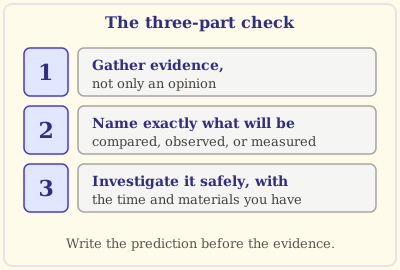
Use this three-part check on any question before you investigate it: Can you gather evidence, rather than only ask for an opinion? Can you name exactly what will be compared, observed, or measured? Can you investigate it safely, with the time and materials you actually have? A prediction is written before you gather evidence. It makes your reasoning visible on the page, and a prediction that turns out wrong is often the most useful entry in the whole notebook. A prediction is not a result, and it does not become correct just because it sounded reasonable when you wrote it.
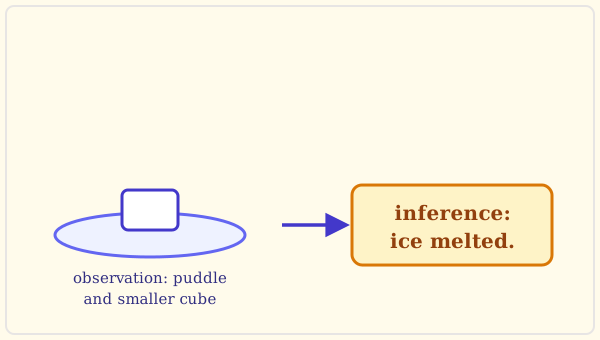
Observation: a clear puddle surrounds the cube, and the cube is smaller than it was five minutes ago. Inference: some solid water melted into liquid water. Testable question: does room temperature change the time two equal ice cubes take to melt completely?
Observation: three leaves droop, and the soil feels dry two centimeters below the surface. Inference: the plant may need water — plausible, but heat, root damage, or disease could also cause drooping, so you mark it honestly with may. Next evidence: check soil moisture the same way each day, rather than declaring the cause on day one.
Why are stones interesting? is broad, and it is partly a matter of opinion. Repair it into Which of these four labeled stones can scratch a copper coin? The repaired question names a specific property (hardness, shown by scratching), a fair comparison (four labeled stones, one coin), and observable evidence (a scratch appears or it does not). Repairing a question usually means trading a big, admiring word for a small, measurable one.
Choose three safe, familiar objects from home — for example a spoon, a smooth stone, and a dry sponge. Without looking, pick one up and write three qualitative observations using touch and, if safe, sound: perhaps cool, smooth, heavy for its size. Then write one inference about what it might be, starting with This may be…, and name the observation that most supports it. Only then look at it and add two more observations now that sight is available, including at least one quantitative observation made with a ruler. Repeat for the other two objects. Afterward, ask yourself which sense gave you the most trustworthy evidence, and where an inference tried to sneak into your observation list. Never taste an unknown material, and never smell one by putting it directly to your nose; if you must check a smell, waft a little air toward your face from a safe distance.
Choose one safe, familiar leaf or stone. Draw it plainly, without yet naming what caused any feature. Then record: three qualitative observations (no numbers), two quantitative observations made with a ruler or another tool — each a number paired with its unit — and two inferences, each beginning with This may mean… and pointing back to the observation it rests on. Finally, write one testable question about the object that names a comparison and a measurable result. Underline every word that came directly from evidence, and circle every word that interprets evidence. If an inference slipped into your observation list, move it — don't erase it. A notebook that shows a corrected boundary is more honest than one that looks tidy because its mistakes were rubbed out.
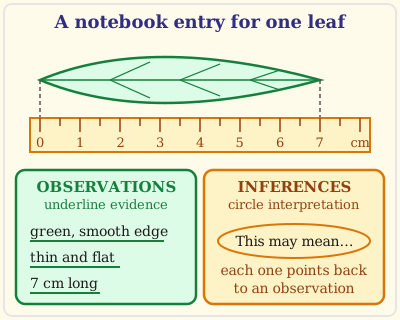
You might be tempted to think 'I saw that it is sick' is an observation. It usually isn't — sickness is an inference drawn from evidence such as spots, drooping, or low activity. Name the evidence first, then add this may mean it is unwell.
You might be tempted to think an inference is just a wild guess. Don't — a sound inference is tied to evidence and prior knowledge; a wild guess is not.
You might be tempted to think a wrong prediction means your investigation failed. Don't — a result that contradicts a prediction has taught you something. Some of the most important notebook entries are the surprising ones.
You might be tempted to think adding more detail makes any question scientific. Don't — a long, detailed opinion question is still an opinion question. Ask whether evidence, not eloquence, could answer it.