Anchor
Name the broad era first.
Ancient, classical, medieval, renaissance, modern, and twentieth-century anchors give students a place to put each new event.
Loading
Just a moment…
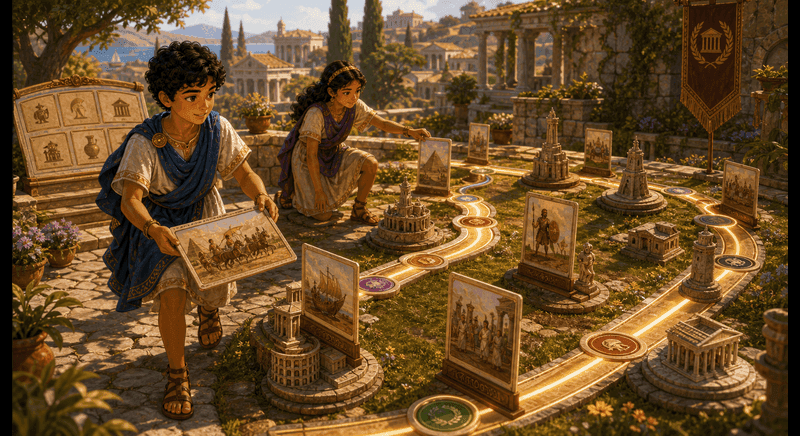
The classical timeline becomes less overwhelming when students can place every event inside a visible story, from ancient river civilizations to the modern world.
6
eras that organize the whole story
160+
timeline events students can place
1
mental map before the dates pile up
The timeline method
Start with the era, place the event, then return often enough that the order starts to feel familiar.
Anchor
Ancient, classical, medieval, renaissance, modern, and twentieth-century anchors give students a place to put each new event.
Place
Dates become easier to remember when students can picture the river of history and the neighboring events around them.
Practice
Short timeline review keeps the whole story from becoming a pile of disconnected names, battles, and inventions.
Classical education is fundamentally chronological. Students don’t study history as a collection of disconnected topics — they study it as a single story, in order, from the beginning to the present. This “timeline-first” approach is how classical educators for centuries have built the mental scaffolding that makes everything else make sense.
The 160 events in the Classical Conversations timeline (or the 161 events Veritas Press uses, or the slightly different set in Memoria Press) all fit into these six broad eras. Memorizing the eras first, then filling in the events, is how the whole thing becomes coherent instead of overwhelming.
4000 BC – 500 BC
The dawn of civilization — the first cities, written language, and the civilizations of Mesopotamia, Egypt, Indus Valley, and China. The Old Testament patriarchs and the rise of the great river-valley cultures.
This era establishes the vocabulary of civilization itself — kings, laws, temples, empires. Without these foundations, none of the later periods make sense.
500 BC – 500 AD
The rise and fall of Greek and Roman civilization. Philosophy, democracy, epic poetry, architecture, and the first great systematic thinkers. The period of the New Testament and the spread of Christianity across the Roman Empire.
The Classical World is the heart of classical education. This is where Latin comes from, where the Trivium originated, and where the intellectual tradition that shaped Western civilization was formed. Every classical education curriculum spends significant time here.
500 AD – 1500 AD
The thousand years between Rome's fall and the Renaissance. Often called the "Dark Ages," but actually a period of remarkable Christian, intellectual, and architectural achievement. The rise of universities, Gothic cathedrals, and the preservation of classical learning by monks.
The Middle Ages are where the synthesis of classical learning and Christian faith happens. Aquinas's Summa Theologica, Gothic cathedrals, Gregorian chant, the university system — all products of this era. Classical education takes this era seriously, not as a dark time but as a formative one.
1500 AD – 1700 AD
The rebirth of classical learning in Western Europe, the invention of the printing press, the Protestant Reformation, and the first explorations of the New World. A period of explosive change in art, religion, science, and geography.
This is where modernity begins. The printing press makes mass literacy possible. Luther's Reformation reshapes Christianity. Newton's physics lays the groundwork for the scientific revolution. Most classical education curricula treat this era as a pivot point.
1700 AD – 1900 AD
Revolutions — political, industrial, and scientific. The American and French Revolutions, the Napoleonic Wars, the Industrial Revolution, and the expansion of European empires. The emergence of the modern nation-state.
The Modern Era produces the institutions we live in today — constitutional government, industrial economies, and the idea of individual rights. Understanding this era is essential for reading current events as anything other than chaos.
1900 AD – Present
Two world wars, the rise and fall of communism, the Cold War, decolonization, the atomic age, the space race, and the digital revolution. The most rapidly changing century in human history.
This is the era your students are most likely to encounter in everyday news. Classical education treats it with the same seriousness as earlier periods — because understanding the 20th century requires all the vocabulary built up in the previous 5 eras.
Classical Quest has 160+ timeline events organized by era, with spaced-repetition drills and Timeline Puzzle + Timeline Order games that make memorization feel like play. Free to start.